This blog documents my work in building and designing a sustainable, hi-tech, moneyless future society.
Translate
Donate to EOS
We aim to build a network of experimental sustainable communities to demonstrate that we do have a sustainable alternative to our current socioeconomic system. Want to help us build for a sustainable future? Please donate what you can:
Thanks!
Well, actually they do. It is just that they are not very
good at it. Humans, on the other hand do display a high degree of skill when it
comes to throwing stones. This skill, argues, Perter Turin forms part of why we
developed a reverse hierarchy when compared to other apes. Chimps, like gorillas,
have a dominate alpha male; the silver back. But humans don’t have such a
beast. It is true that some people do get to such a position in our modern
societies but the evidence suggest that for much of our existence as a species
on this planet, humans formed egalitarian societies. If an upstart occurred within
a community, the ability to effect at a distance was able to put down (i.e.
kill) the upstart through cooperation with minimal risk of harm to
participants. Spears, bows and arrows, and eventually fire arms just added to
our power to effect at a distance. Perter Turin argues that this violence encourages
cooperation within groups. Competition between groups forms the main driving
force for cooperation within groups. Cooperation is destroyed with competition within
groups. Warfare is the ultimate competition between groups. The loser has much
to lose! Victory goes to those who cooperate the best.
Perter Turin takes us on a tour of human cultural evolution to make his point.
Over the millennia our culture has evolved from egalitarian societies
to god-kings to empires to mega-empires and on to today. Not smoothly. Not
perfectly. But over time we have become more and more cooperative and more and
more peaceful (with the exception of a rise in violence during the stone age). We
lost egalitarianism along the way but not for good. Equality and trust strengthens
cooperation so we have tended to return towards more egalitarian societies
again.
The benefits of cooperation are self-evident. We can obtain
an exponential increase in our ability to do things if we work together towards
a common goal. Over many millennia we have
changed as a species to become the most cooperative animal on the plant. Our
ability to cooperate overtook that of ants 2000 years ago. Today we build complex projects that take hundreds
of millions or more people working together, such as the complex distributed
network of international air travel.
But cooperation is not easy.
The benefits of cooperation are self-evident. So why, then,
do we have defaulters? The benefits to society as a whole might be exponential
but for the individual it can be costly. If it takes 1000 warriors to defend a
village and you are one of them then the best action for you would be to default.
999 warriors could do just as well without you and you will not run the risk of
injury or death. You get all the benefits but none of the costs. But if everyone
reasoned like that then no one would defend the village and you, as well as
everyone else, would run the risk of a nasty death or enslavement. So,
societies developed ways to punish defaulters. Yet, in cooperative systems we
still can find defaulters.
So, how do we build cooperation? Well, it appears there are
a number of important ingredients. Although Perter Turin does point out that
the science of cultural evolution is still young and we have much more to learn.
However, we can say the following for
now:
·Enhance cooperation within the group
oIncrease openness
oIncrease equality
oIncrease trust
·Avoid things that destroy cooperation within a
group
oInternal competition
oFear of group reprisal
oCorruption
·Increase competition between groups
oWar is the best for this. Nothing like life threatening
danger to get you to work with others but I hope with the application of
intelligence we can come up with a more socially acceptable alternative.
Thoughts on how this would work with EOS? Cooperation
between like minded groups seems very difficult within the alternative or RBE community.
Perhaps we don’t feel threatened yet?
I find it quite
fascinating watching the current migrant crisis in Europe and
Sweden's response to it. Combine that with the actions of the
previous Alliance government in Sweden and it appears to me that both
the left and right in Swedish politics suffer from a collective form
of “insanity”. Although I don't think this “insanity” has its
limits within Sweden. On the right we have neo-liberalism; a “fnck
your buddy” ideology that has demonstrate an ability to create
short term economical miracles and long term nightmares. Not
surprising as it has its foundations in a distorted view and
erroneous application of science, especially Game Theory and Chaos Theory.
The left, however, has its own kind of collective insanity; often
referred to a the “regressive left”; the “I hate myself”
ideology. With its political correctness, cultural relativism,
identity politics, and socially acceptable anti-Semitism, it has a
very detached view of reality "where facts are just so untrue" and
feelings rule.
Modern Educayshun (the regressive left )
The Information
Flood
We live in a sea of
information. Our five sensors constantly feed data to our brains
giving us not just information about the physical world but also
about social interactions and, as a result of modern technology,
events the other side of the planet, on other planets, other star
systems and even other parts of the Universe far back in time. We
don't need all this information and our brain acts as if it employs a
filter that filters out anything that we find not relevant. And how
do we determine if the information has any relevance to us? Well, the
filter acts like it models aspects of the world around us. If the
information agrees with that world view it passes through. This
allows us to concentrate on what we need and prevents us from drowning
in the tsunami of information that greets us.
I have seen people
suggesting that society has become more “dumbed down” and point to
the decline of education and the rise of certain politicians. But on
the other side, we also see a rise in IQ suggesting we have become
more intelligent. Perhaps, we haven’t become “dumbed down” but
we have less and less of an idea of what happens in the World because
we have so much information that we can only utilise an ever
decreasing percentage of that information? This filtering helps us to
protect ourselves from information overload.
However, it does
have a disadvantage; what happens when our world model deviates from
reality too far? Well, our world model no longer agrees with reality
therefore, it will filter out any information that will show us that
we have deviated from reality. We become more and more deluded. As we
deviate further from reality we can become stupid. Stupid in the
technical sense of an adaptive/maladaptive behavioural pattern that
can results in harm to ourselves or others. Pain becomes the method
that gives us a way to get out of this. In the past nature had a way to correct this. If you believed a saber tooth tiger was a cute cuddly and misunderstood animal you probably didn't get to breed. But today, especially in Sweden, life is too easy.
As reality breaks through it
become distressing to us. A situation referred to as cognitive
dissonance. Although it can sometimes work the other way. People who
have suffered mental torment dive deeper into the delusions to escape
pain.
The Reality of
Reality
We live in a real
physical, complex, multi-agent, dynamic and chaotic society. The
neo-liberals partly understand that but the regressive left appears
to have absolutely no idea of it. However, the neo-liberals rely on
models that scientist have demonstrated false, in some cases as far
back as the 1950s. Neo-liberals understand the multi-agent aspect of
society but only model such agents as selfish agents who seek
to maximise their own utility. A behavioural pattern that only
economists and psychopaths utilise. Real people display far more
complex behaviour that doesn't fit the model. Neo-liberals correctly
assume that an economic system exhibit the characteristics of a
self-organising system but make an error in assuming that, left
without government interference, the system will self-organise to an
optimal state. However, the phase space of a socio-economic system
has many optimal stable states, not all of which benefit people. When
it all goes wrong, like in the 2008 financial crisis, the "do more of
what caused the problem" solution becomes the standard neo-liberal solution to
the crisis.
The neo-liberals
fail to understand other aspects of reality such as the physical nature
of resources. We cannot sustain infinite exponential growth with
finite resources.
The government forms
part of the system and can act to limit the stable states of the
system and the paths through phase space that the system can take
such as with functional socialism once employed in Sweden. For
example, left to its own the system will result in a state where a
small number of agents in the system starts to horde and ever
increasing amount of resources; the rich get richer. This produces a
state not beneficial to the majority and can cause the system to
collapse. Governments can act, through taxes, to limit this aspect of
the system making it more equal and more beneficial to all, keeping
it stable.
We can see the real
physical, complex, multi-agent, dynamic and chaotic nature of our
socio-economic system if we look at the migrant crisis in Sweden.
Sweden once formed an example of a relatively cultural homogeneous
society. Apart from the Lapps (who don't differ too significantly
from Swedes regarding values), the Swedes acted as agents that basically followed the
same rule set with only minor variations. The agents reached an
evolutionary stable state which contributed to the rise of Sweden
from a third world like nation to a modern wealthy post-industrial
nation. The generous Swedish immigration policy has, however, brought
in new agents into the system using a different rule set. What we
should see should exemplify a change in the dynamics of the system
depending on the flow of immigrants coming into Sweden, like looking
at a Lorenz Water wheel. A Lorenz Water wheel has a set of buckets
attached to a wheel. The buckets have holes in them. As the water
flows in it also flows out, though the holes. If the flow in is too
slow the water will flow out too fast for the wheel to turn. However,
if the flow becomes just right and balances with the flow out then
the wheel turns and behaves as a normal water wheel. However, the
really interesting behaviour occurs when the flow in becomes greater
than the flow out. The wheel behaves chaotically; first spinning one direction then the other in an unpredictable pattern.
A Lorenz Water Wheel
also forms an example of a real physical, complex, multi-agent,
dynamic and chaotic society. Much simpler than our socio-economic
system but our socio-economic can display the same sort of chaotic
behaviour to inputs that flow too fast. A flow of people from one
group to another has its advantages; new ideas and new blood. But if
it becomes too excessive it can destabilise the society. A society,
however, has many more complexities than a water wheel and it is not
just the amount of immigration but also the type of immigration. Not
all cultures follow the same rule set but we can often find overlaps
or similarities. The greater the difference in rule sets the lower
the threshold before chaotic behaviour could emerge. When you get
Swedish politicians say they want 30 million immigrates (when we have
7.5 million ethnic Swedes as it is) and they think people in Sweden will
still speak Swedish as the main language. Or when you get politicians
saying Sweden has no limits to the amount of immigrates it can take.
Or saying Sweden doesn't belong to the Swedes. Or saying they will
make a temporary adjustment to reality and the majority of Swedes go
along with this, you get an indication of how detached from reality
Swedish politicians and people have become.
A Lorenz Water Wheel
Now enters
Ultrasociety. Ultrasociety, a book by Peter Turchin, looks at the
rise in cooperation between humans. It takes an approach called
cliodynamics which aims to present the evolutionary logic behind the
development of our species through history; why do we cooperate?
Basically, we evolved as we did to form such complex, cooperative,
peaceful societies through war; as if to become fully human we need
struggle, pain, and suffering. As if we need to be purified through
fire. Pain and suffering have a role to play; they can help bring us
back to reality. I have a friend who describes Sweden as damaged by
200 years of peace and the evidence would suggest he got it right.
Perhaps that accounts for what has gone wrong in Sweden? Why we see
the decline in education and in social systems? Why the state became
so strained last year to the point that people were talking about a
collapse (although I think we were far from a collapse)?
On to the Future
But what is the
relevance of all this to a future, moneyless, sustainable society? I
often see a tendency within the futurist community to dream of
societies without pain, suffering or war; beyond politics, poverty
and war as Jacque Fresco puts it. Some transhumanists go so far as to
want to re-engineer nature so that animals won't cause suffering to
other animals; the lion will lay down with the sheep. Human behaviour
emerges from both genetics and environment, each feeding back on the
other. We evolved in a world of violence and suffering. But if we do
that, if we create a society that has no war, no suffering of any
kind, if we take away the pain, could we create for ourselves an
insane nightmare?
Having vision doesn’t bring about the reality; we also
need to act. So, having some idea of what we mean with a Star Trek Economy, how
do we bring one about? Especially, how do we bring one about when we have
limited resources?
Evolution
Rick Webb sees the evolving from the social democracies
in Europe. The European social democracies achieved a great success during the
20th century as they brought countries Such as Sweden form the level of a poor “third
world” nation to the level of a modern wealthy industrial nation in the span of
a life time. However, they began to run into problems of their own towards the
end of the 20th century for various reason (but all to do with their success).
In addition, the social democracies do have quite the right vision. Although
equality features highly in both the vision for a Star Trek economy and the
Social democracies, social democracies still have the idea of work for all as
central. Whereas, in a Star Trek economy we would see technology more at the
centre reducing the need for work. Thus, we would need a change in direction
away from the current social democracies. It can work out harder to change
something than to start again. So, rather than redirecting one ideology,
perhaps we should work towards build another?
On saying that, the idea of a Star Trek economy does
have a lot of overlaps with social democracy so I could see many social
democrats would also support a Start Trek economy. This could lead to another
way to bring about such a system; work within the groups and organisations that
have similar goal with a view of society. For example, a Star Trek economy
should have a sustainable nature and balance between nature and society. In so
doing it overlaps with many environmentalist. It would not take a hug step to
go from sustainability or equality to the sustainable, equal and moneyless society
of a Star Trek like economy.
Here in I see one way we could go; evolution. From a
multiple of compatible ideologies in the world we could see a gradual step towards
the idea of sustainable, moneyless, science based Star Trek economy. For that
to work we would need many small groups to star working on the same goal; independent
groups, self-starting groups to start with. As more groups form with the same
vision, networking will occur and strength each group. As we have more and more
follower we have the potential to raise finances and in doing so, to start to
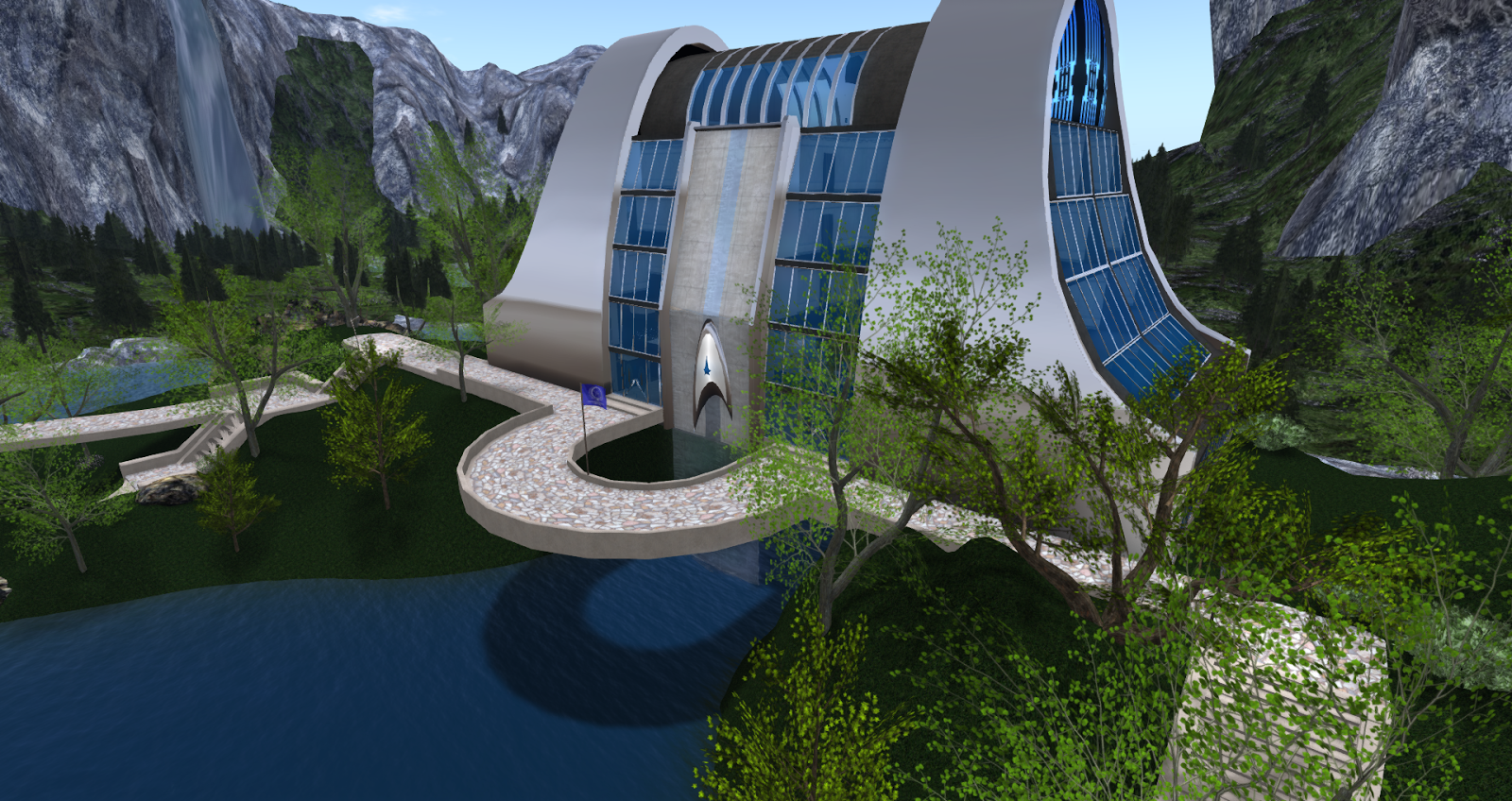
build something. Small sustainable communities at first; “starbases” on Earth.
The network could grow and evolve towards a type one civilization; working
towards the vision.
The vision has a key role; the vision of a future, a
Star Trek, economy, unites otherwise separate groups. Beyond vision, however,
we also need skill and willingness to act. So many people have enthusiasm but
so few have skill.
Building starbases on Earth?
Stepping Stones.
The process I outlines of a vision orientated goal
directed building up of a sustainable moneyless system I call stepping stones.
What I present could form one way to achieve such a system with minimal resources.
We just need people and skills. Any volunteers?